 ← Blog vs. competitors • 5 min read
Railyard vs Laravel Cloud: scale-to-zero or a server you own

July 31, 2026 · 5 min read
Laravel Cloud is for teams who want a fully managed Laravel or Symfony platform that scales to zero when idle, running on the Laravel team’s own AWS infrastructure, with compliance built in at the higher tiers. Railyard is for teams who want the same automatic Laravel detection on a server in their own cloud account, priced flat per team instead of metered by the hour. Neither is wrong; they start from opposite assumptions about who should own the compute underneath.
What each one actually is
Laravel Cloud runs your app, database and cache on AWS infrastructure the Laravel team operates, not a server you provision yourself. Pricing is usage-based on top of a flat plan fee: Starter is $5/month (first month free, with $5 of monthly usage credits included), Growth is $20/month, and Business is $200/month, with compute metered by the second and paused while an app is asleep.
Railyard runs your app on a server in your own cloud account (DigitalOcean, Hetzner, Vultr, AWS, OVHcloud, Scaleway or UpCloud), or any Ubuntu box you already have. Your provider bills the server directly; Railyard’s own fee is flat per team: $19/month for Pro, covering up to five servers and unlimited apps.
Where Laravel Cloud is better
Laravel Cloud’s scale-to-zero is genuinely impressive: apps, MySQL, Postgres and cache all scale to zero and wake in under 500ms, so a quiet side project can cost under a dollar a month. Preview environments spin up for every pull request with managed queues already attached, and Laravel and Symfony apps are auto-detected with no configuration at all. Business and Enterprise plans carry SOC 2 Type II, HIPAA and GDPR compliance plus an advanced WAF built in, and spending limits pause compute automatically at a set budget, with alerts at 50%, 80% and 100%.
If you want a Laravel or Symfony platform with nothing to provision, size or patch, and compliance paperwork is part of the requirement, Laravel Cloud answers both directly.
Where Railyard is better
The difference is where the server lives and how the bill behaves. Laravel Cloud’s compute is metered by the second on top of a plan fee, so a busy app costs more as it wakes more often; Railyard’s $19/month Pro fee doesn’t move with usage, and the server itself is billed separately, at your cloud provider’s price, with no markup. Preview environments on Railyard are unlimited on Pro at that same flat price, rather than something that adds to a metered bill.
Because the server is yours, it keeps running if you cancel Railyard. Your app is an ordinary container on an ordinary server behind a standard proxy; losing dashboard access doesn’t touch what’s running underneath. Laravel Cloud’s compute runs on infrastructure the Laravel team operates, so cancelling stops it there.
Day-to-day differences that matter
Laravel detection. Both auto-detect a Laravel app with no configuration. Railyard specifically reads composer.json and .env.example, runs php artisan migrate --force as the release command, generates APP_KEY in Laravel’s own format, and adds Horizon or Reverb as their own processes when either is installed, the same depth of detection Laravel Cloud offers.
Scaling. Laravel Cloud’s scale-to-zero is true per-request scaling with no server behind it at all. Railyard supports sleep-when-idle for apps, configurable from never up to a day of inactivity, which is a similar cost outcome triggered by idle time rather than true per-request scale-to-zero.
Pricing shape. Laravel Cloud is a plan fee plus metered compute that grows with every awake hour. Railyard is a flat $19/month per team on Pro, plus a server bill from your cloud provider that you can see and size yourself.
Compliance. Laravel Cloud’s Business and Enterprise plans already have SOC 2 Type II, HIPAA and GDPR in place. Railyard has none of those yet, which matters if a signed report is a near-term requirement.
Databases. Laravel Cloud’s Postgres, MySQL and cache all scale to zero as part of the platform. Railyard’s databases run continuously on your server, with scheduled backups verified by restoring them and point-in-time restore on Pro, but no scale-to-zero behavior of their own.
Server maintenance. Because Railyard’s servers are yours, each one reports its own pending operating-system updates and can apply security patches overnight automatically, with Postgres able to move between major versions in place. Laravel Cloud manages its own infrastructure entirely on its side, so there’s nothing comparable to check from your end.
Who should pick which
Pick Laravel Cloud if scale-to-zero compute fits your traffic pattern, and SOC 2, HIPAA or GDPR compliance is a near-term requirement you don’t want to build around separately. Pick Railyard if you want that same automatic Laravel detection on a server in your own cloud account, for a flat price that doesn’t move with how often the app wakes up.
Laravel Cloud doesn’t offer a guided export today, so moving to Railyard means pointing Railyard at a new server and redeploying from your existing repository, with composer.json and .env.example read automatically either way. See how Laravel deploys work on Railyard, or the full comparison: Railyard vs. Laravel Cloud.
FAQ
Does Railyard support Laravel Octane the same way as Laravel Cloud?
Yes. With laravel/octane in composer.json and no Dockerfile, Railyard runs the web process with FrankenPHP automatically, the same runtime Octane expects.
Is Railyard cheaper than Laravel Cloud?
It depends on traffic. A genuinely quiet project that scales to zero most of the time can cost under a dollar a month on Laravel Cloud. A continuously busy app is more predictable on Railyard’s flat $19/month Pro plan plus a fixed server cost, since nothing is metered by the hour.
Can I get SOC 2 or HIPAA compliance on Railyard?
Not yet. Laravel Cloud’s Business and Enterprise plans already include SOC 2 Type II, HIPAA and GDPR. If that’s a near-term requirement, Laravel Cloud is the better fit right now.
Does Railyard scale to zero like Laravel Cloud?
Not at the same level. Railyard’s sleep-when-idle puts an app to sleep after a configurable period of inactivity and wakes it on the next request, which saves cost similarly but isn’t the same true per-request scale-to-zero Laravel Cloud offers for apps, databases and cache together.
What happens to my app if I cancel Laravel Cloud versus cancelling Railyard?
Laravel Cloud’s compute runs on infrastructure the Laravel team operates, so cancelling stops it. Railyard’s app runs on a server you own, so it keeps answering requests if you cancel; you lose the dashboard managing it, not the server.
Does Railyard detect Horizon and Reverb automatically?
Yes. Horizon is added as its own worker process once laravel/horizon is in composer.json, and Reverb is added as its own process once laravel/reverb is installed, both without any extra configuration.
Railyard and Laravel Cloud, feature by feature
| Feature | Railyard | Laravel Cloud |
|---|---|---|
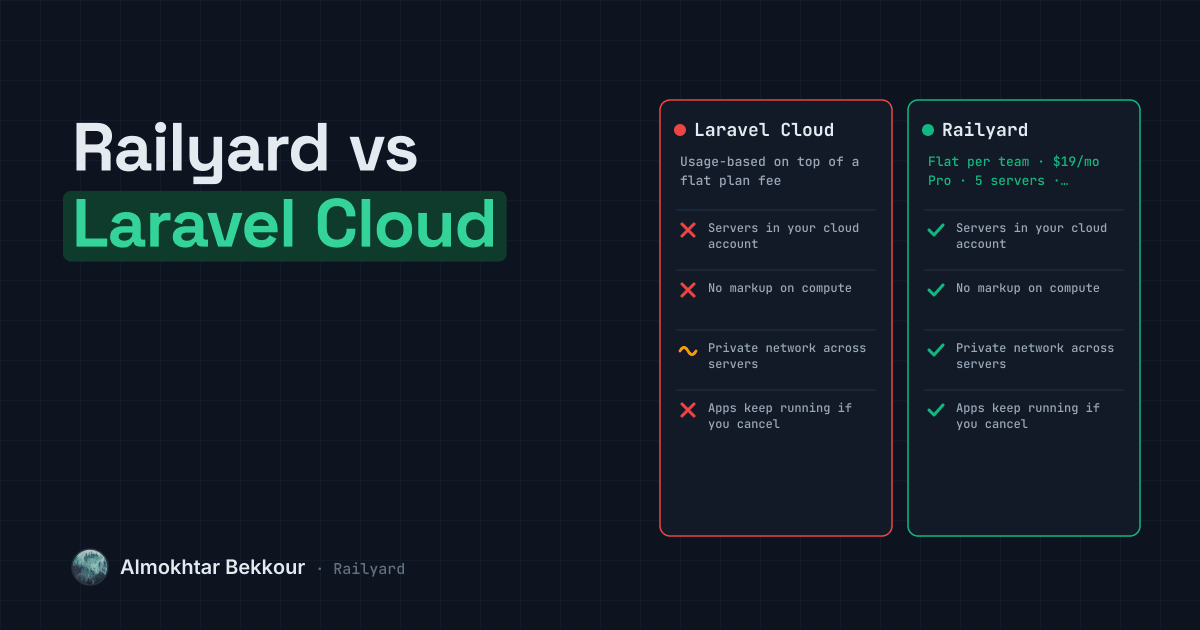
| Servers live in your own cloud accountConnect DigitalOcean, Hetzner, Vultr, OVH or AWS and Railyard provisions and deploys straight onto a server in that account. | yes | no |
| No markup on computeYou pay your cloud provider directly, at their price. Railyard's fee is a flat amount per team, not a cut of your server bill. | yes | no |
| Bring any Ubuntu server over SSHPoint Railyard at an existing server's host, a user and an SSH key, and it connects and takes over from there. | yes | no |
| Deploy from GitHub on every pushConnect a repository once; every push to the branch you choose builds, releases and swaps traffic automatically. | yes | yes |
| Preview environment per pull requestEach pull request gets its own copy with its own URL and a comment on the PR, torn down automatically when it closes. | yes | yes |
| Managed databases with scheduled backupsPostgres, MySQL, Redis and more are provisioned on your servers, with backups scheduled, verified by a restore, and kept for the window you set. | yes | yes |
| Point-in-time database restoreRestore any database to any minute inside your retention window, into a new database alongside the original. | yes | partial |
| Visual canvas of your projectEvery service, database and the links between them render as a live picture you can edit and deploy from. | yes | no |
| Private network between servicesEvery server Railyard manages joins a private network automatically, so services talk to each other without touching the public internet. | yes | partial |
| Sleep when idle, wake on requestAn app with no traffic for a while stops its process, then starts it again the moment a request arrives. | yes | yes |
| Plain-language reason when a deploy failsA failed deploy names the cause in plain language — a failed health check, a bad build, a missing variable — and links straight to the fix. | yes | partial |
| Apps keep running if you cancelYour apps are plain containers on servers you own behind a standard proxy. Cancel Railyard and they keep serving traffic; you just lose the dashboard. | yes | no |
Where Laravel Cloud is better
- Apps, MySQL, Postgres and cache all scale to zero and wake in under 500ms, so a quiet side project can cost under a dollar a month.
- Preview environments spin up for every pull request with managed queues attached, and Laravel and Symfony apps are auto-detected with no configuration.
- Business and Enterprise plans carry SOC 2 Type II, HIPAA and GDPR compliance, plus an advanced WAF, built in.
- Spending limits pause compute automatically at a set budget, with alerts at 50%, 80% and 100%.
Pick Laravel Cloud if
Pick Laravel Cloud if you want a fully managed, scale-to-zero Laravel or Symfony platform with SOC 2 and HIPAA built in, and don't need the servers in your own cloud account.
Pick Railyard if
Pick Railyard if you want unlimited preview environments and a flat $19 a month per team instead of a plan fee plus metered compute that grows with every awake hour.
Pricing
- Laravel Cloud
- Usage-based on top of a flat plan fee: Starter is $5/month (first month free, includes $5 of monthly usage credits), Growth is $20/month, and Business is $200/month; compute is metered by the second and pauses while an app is asleep.
Sources: Laravel Cloud: Pricing · Laravel Cloud: Laravel Cloud